
Here’s the truth: your company is likely losing millions of dollars each year. Nearly two-thirds of companies spent almost $3 million upgrading legacy contact center systems. Additionally, one in four businesses says their legacy contact center system can't support AI customer service tools and other modern contact center technology.
While it might seem like your legacy support platform is working on the surface, it’s quietly draining your budget through maintenance costs and missed opportunities for increased revenue and call center agent productivity.
The bottom line? Outdated technology leaves you at risk of hemorrhaging money and losing ground to your competitors. Below, we go over the actual cost of maintaining legacy contact center systems and how modern contact center solutions address these issues head-on.
The true price of legacy contact center systems
Outdated support platforms can have a detrimental impact on your company’s budget and ability to compete in an increasingly crowded telecom market. Below, we dive into a few ways legacy contact center systems negatively impact call center performance.
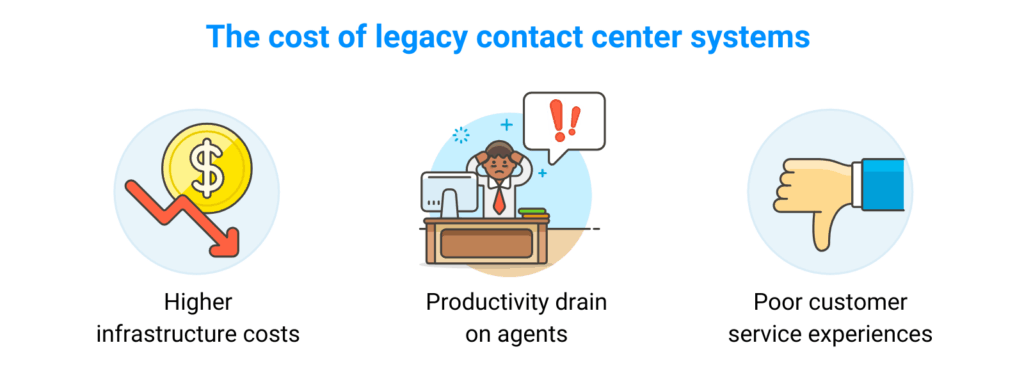
Escalating maintenance and infrastructure costs
You might know that legacy systems can take a serious bite out of your budget, but just how much is it costing you? It’s probably more than you think. It’s estimated that these older platforms eat up to 80% of a company’s IT budget. Additionally, as the technology powering your contact system ages, it becomes increasingly difficult to find qualified personnel to repair it.
So, how much does it cost to maintain these older tech support platforms? Research also shows that businesses spend as much as $30 million annually to keep their legacy systems up and running. This is money that could be saved or re-allocated to other much-needed resources or campaigns for your business. In short, outdated technology can have a devastating impact on call center efficiency and company spend.
Productivity drain on contact center agents
Legacy contact center systems don’t just drain your budget; they can also tank your agents’ productivity. A survey found that employees spend nearly a third of their time on manual tasks due to disparate tech systems. IT issues such as this cause employees to lose up to 22 minutes per day to tech or equipment problems.
Legacy systems that don’t integrate with modern tech stacks force agents to switch between disconnected platforms constantly. They often have to enter data manually, which not only adds unnecessary tasks to their already full plate but also increases the risk of data entry errors.
All of this makes contact center agent onboarding that much more challenging, which can be detrimental to employee retention. Additionally, repetitive, manual work due to legacy systems can also seriously impact employee engagement. As a result, agents are much more likely to start looking for a new job. The cost of replacing employees adds up quickly, to about twice the employee’s salary. This is just another way that outdated technology can negatively impact company operations and budget.
Negatively impact critical call center metrics
Legacy contact center systems can also impact key contact center metrics. For example, libraries of physical devices quickly become outdated, making it harder for agents to deliver fast, effective customer service. This increases average handle time (AHT) for tech support cases.
Outdated tech can also lead to reduced first-call resolution rates (FCR) if agents don’t have accurate information or up-to-date device libraries to provide effective troubleshooting. Not only does this increase the cost per customer interaction, but it also impacts critical CX metrics. As a result, your company could see increased customer rage. Negative tech support experiences also increase the likelihood of higher customer churn rates, due to the impact on the customer experience.
Poor customer service experiences
A lack of a comprehensive support platform often leads to poor customer service experiences. Customers who have a bad service interaction with your company aren’t giving second chances. 96% of customers will leave after a single bad service experience. That means if your legacy contact center system leads to long call center wait times or multiple calls or transfers to resolve an issue, you risk losing a majority of your customers.
The cost of bad customer service adds up fast. It’s estimated that poor quality customer service costs businesses nearly $4 billion globally. Legacy contact center system software often provides customers with only a single channel for help: calling your contact center. This can be especially problematic for companies that want to attract and retain lucrative Gen Z customers, also known as zoomers. Only 17% of zoomers want to call to speak to a person.
Additionally, due to call-only support, many legacy systems aren’t able to provide the speedy service this generation expects. This generation grew up in the era of instant streaming and grocery delivery. Research shows they’ll hang up after waiting on hold for less than a minute. The bottom line? If your legacy contact center software doesn’t provide speedy customer service, your customers will go elsewhere.
How modern contact center solutions address these challenges
Now that you know the hidden costs of legacy contact center systems, you might be considering exploring more modern call center software. But how do you choose the right one to integrate into your tech stack, and how exactly do these newer solutions eliminate or reduce these problems? Here, we’ll dive into how modern contact center solutions address these challenges head-on.
Comprehensive support platforms enable flexible work
These days, many contact centers are implementing remote or hybrid customer service strategies. So, how can you ensure your agents can deliver the same high-quality customer service from the office or home? This is where legacy systems that rely on call-only channels fall short.
Thankfully, modern contact center solutions that offer tools such as video chat customer support can help. Undoubtedly, live video support is the future of customer service. It streamlines communication between customers and agents, allowing for faster service resolution and reducing the need for costly truck rolls.
Improve the customer experience
Implementing modern tech support tools that offer features such as video support can be valuable for your customer retention strategy amid rising customer expectations for faster service resolution. At the same time, it allows you to balance speed with demand for more personalized customer service experiences.
Additionally, comprehensive support platforms offer customer self-service tools to improve the customer experience. Offering automated support is crucial, as 88% of customers expect self-service options. This is especially true of Gen Z customers, who largely prefer to resolve tech issues on their own. As a bonus, self-support tools let customers skip call center queues and access instant tech support.
By providing the timely, personalized customer service your customers expect, you can improve critical call metrics, such as customer retention rate and net promoter score (NPS). Customers who have positive service experiences are much more likely to stay loyal to a brand and make repeat purchases. This means that modern contact center software can take your call center transition from call hub to revenue driver.
Leverage artificial intelligence (AI) to scale support
AI customer service is no longer a nice-to-have, but a must-have for successful telecom businesses. Customers expect your company to respond to their communications within five minutes or less. However, there are only so many hours in a day, and so many staff you can hire. So, how can you provide speedy customer service to thousands, or millions, of customers?
This is where tools such as conversational AI chatbots become a critical differentiator for your brand. They often get a bad rap, but the truth is, AI chatbots deliver quality customer service. That’s because today's chatbots typically leverage large language models (LLMs) to better understand the nuances of customer requests.
As a result, modern chatbots are no longer confined to handling simple FAQs. They can interpret error codes and even provide step-by-step guidance to resolve tech support issues. In fact, Gartner predicts that by 2029, AI will handle 80% of customer support requests. This makes it much easier to scale support without increasing case burdens on agents. It also allows customers to access the help they need at any time of day or night.
Don’t let legacy contact center systems hold you back
Outdated tech creates more than simple headaches. It can have a devastating impact on your bottom line and the customer experience. In turn, this can impact your company’s reputation and make it difficult to compete in an increasingly crowded telecom market. By upgrading to modern contact center solutions, your business could reap benefits such as improved NPS, reduced customer churn and quickly scale support to meet customer demands.
Are you looking for more concrete examples of how modern contact center solutions drive revenue? Verizon Wireless saves tens of millions of dollars annually with Ozmo’s tech support solutions. Download the case study to find out how.