Companies that use AI instead of humans are making a costly mistake. Nine out of 10 customers say they prefer human agents over chatbots in a customer service interaction. Why? Simply put, customers think real people in your contact center create a better support experience. In short, while technology can do many things, AI can’t replace humans in your contact center.
Yet, customer expectations are higher than ever, with two-thirds of customers saying they expect a company to respond to their communications within five minutes or less. So, how does your company thread this very delicate balance of fast customer service without overburdening agents or hiring exponential numbers of new staff?
The answer is harnessing the power of AI-powered agent assistance. Instead of using technology to replace people, leverage AI to improve call center agent productivity. Companies looking to stand out from the competition can use agent assist AI to support agents where accuracy and speed matter most: during live interactions.
Below, we go over what AI-powered agent assistance is, how it works and why it’s becoming essential for modern CX teams.
What AI-powered agent assistance is (and what it’s not)
A common myth about AI customer support is that it’s meant to replace people. While early AI adoption efforts focused on using conversational AI chatbots for call deflection, companies are now pivoting to using AI to augment agent performance during live service interactions.
So, what sparked this change? In short, customer feedback. According to the National Customer Rage survey, the number one frustration for customers is the inability to speak with a human. Despite all the things AI can do, technology just can’t replace the empathy unique to your human agents. Now, companies are pivoting to use real-time agent assist to create better customer service experiences.
AI-powered agent assistance is all about using AI to augment agent performance during live interactions. It doesn’t use AI to replace the agent, only to help them resolve customer issues faster and more effectively. During a customer interaction, the AI assistant might surface information from your company's knowledge base, recommend next steps or provide other critical context while the agent is interacting with a customer. It’s all about helping agents do their jobs better to create a more streamlined tech support experience.
How does real-time agent assist AI work during a live interaction?
Real-time agent-assist AI supports agents during live service interactions, enabling them to make accurate diagnoses and resolve issues quickly.
It starts by analyzing information from the live interaction. This includes what the customer is saying, the device type or service, and any previous interactions. The goal isn’t to overwhelm the agent with data, but to identify intent and narrow down the most likely issue. It then matches the situation to known troubleshooting paths and support scenarios, and locates relevant guidance. Instead of agents having to search across multiple systems or rely on memory, they can leverage AI to provide the right information at the right time.
The human agent then receives tailored recommendations such as suggested next steps, device-specific troubleshooting, or critical reminders that prevent missed steps. Such real-time support is especially helpful for junior agents, who often lack experience and expertise. Research from Stanford and MIT found that customer service agents using generative AI tools saw a 14% increase in productivity, with the most significant gains among inexperienced agents. As a result, AI-powered agent assistance helps teams balance delivering consistent support without sacrificing the human connection customers crave.
Why agent assist matters in telecom and broadband
AI-powered agent assistance can benefit all types of businesses, but it’s especially critical in telecom and broadband customer support. Services like WiFi or physical devices such as smartphones and laptops are now an integral part of our daily lives. Issues such as device activation, WiFi setup, outages and app updates can bring your customers’ day to a halt.
When these services or devices break down, it can affect both customers’ work and personal lives. For example, a doctor might find themselves unable to join a scheduled telehealth appointment. Or, customers can’t stream their favorite shows to unwind after a long day at the office.
When customers experience these sorts of problems, it can make them feel very frustrated, leading to dissatisfaction with your brand. This means it's critical that your human agents can troubleshoot quickly and accurately under pressure. Leveraging tools like AI chatbots to deliver quality customer support and troubleshooting can help agents handle more complex tech support requests in less time. By using AI to augment their tech support interactions with customers, agents can play a critical role in improving key contact center metrics and overall brand sentiment.
Example use cases for agent assist AI
Below are a few ways you can use agent assist AI to enhance contact center performance and streamline the tech support experience.
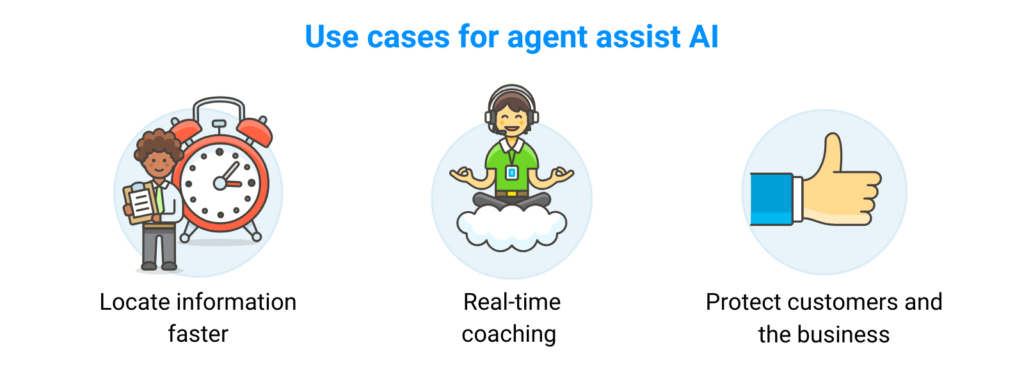
Agents can locate critical information more quickly
During live service interactions, time spent searching for information adds friction for both agents and customers. In many call centers, answers live across multiple knowledge bases, documentation and tools, forcing agents to pause the conversation or rely on memory recall when issues become complex.
Agent assist AI addresses this by surfacing relevant information as the interaction unfolds. Instead of leaving agents scrambling for answers, the AI identifies intent and presents the most relevant guidance for each customer's situation. Examples of this in action include basic troubleshooting and device-specific instructions. This results in a smoother interaction, where agents stay focused on the customer's needs rather than navigating disparate systems.
Industry analysts have long emphasized the role of strong knowledge management in service performance. When accurate knowledge is embedded directly into agent workflows, teams can resolve issues more quickly and reduce unnecessary friction.
Real-time coaching for human agents
Not every issue has a clear or familiar resolution path, especially in telecom and broadband environments where agents support a wide range of devices and services. The AI guides agents by offering prompts and recommendations throughout the interaction, rather than after it ends.
This real-time coaching is particularly valuable for newer agents, who may still be building experience across different scenarios. By reinforcing correct steps and highlighting relevant information, agent assist AI helps reduce hesitation and supports more consistent outcomes across the team. Over time, this reduces reliance on supervisors and creates a more balanced workload among both experienced and inexperienced agents.
Balance protecting customers and the business
In regulated or process-driven environments, missing a step can create risk. For example, agents may be required to inform customers that their calls are recorded for quality assurance.
Agent assist AI can flag omissions or required disclosures during the interaction, helping agents follow established procedures without breaking the flow of the conversation. This improves consistency while protecting both the customer experience and the business.
How to choose an agent-assist AI solution
Not all AI-powered agent assistance is created equal, so it’s essential to evaluate your options carefully. Start by looking at ease of integration. Agent assist AI should fit naturally into your existing contact center tools and workflows. If agents have to switch systems or change how they work, adoption will slow and they'll lose out on the benefits of real-time guidance.
Next, evaluate the quality of the knowledge behind the AI. Agent assistance is only as strong as its knowledge base. Solutions grounded in validated, up-to-date information are far more likely to earn agent trust than tools that rely on generic responses.
Also consider ease of adoption. How quickly can agents feel comfortable using the tool during live interactions? Guidance should feel supportive and unobtrusive, not disruptive to the conversation.
Finally, consider whether the solution partner has experience working with clients in the telecom and broadband industries. Supporting complex devices, services and troubleshooting paths requires domain-specific workflows. Generic tools can fall short in these environments.
Choosing a solution that aligns with how agents actually work reduces friction and improves adoption.
Agent assist AI is now an essential part of contact center tech stacks
Good AI customer support isn't about replacing human agents. It's about supporting them where accuracy, speed and empathy matter most. By delivering guidance during live interactions, agent assist AI helps teams provide timely and consistent tech support without losing that vital human touch.
As customer expectations rise and support requests grow more complex, agent assist AI is becoming essential for successful modern contact centers. For telecom and broadband teams, it offers a way to scale support while preserving the human-to-human interactions that customers crave.
Are you looking to learn more about how to integrate AI into your contact center? Check out our free e-book to learn how you can use AI effectively in your customer service strategy. Download your free copy today.