Your telecom company wants to stay ahead of competitors in an increasingly crowded market. You’ve seen a lot of headlines about using AI to improve the customer experience and know you could use it to differentiate yourself from competitors. So, after careful research, you invest in a contact center AI solution.
However, despite this, it soon becomes apparent that customers are unhappy. Tech support tickets aren’t resolved any faster and key contact center metrics haven’t improved. So, what’s going on?
Many telecom and broadband businesses implement AI in contact centers to reduce business expenses and lower call volume. After some initial easy wins, the benefits soon stall. Typically, it’s not because there’s something wrong with the AI software itself. Rather, the source of the problem is how businesses use AI once it's implemented.
However, the solution isn’t to add more tools to your tech stack. Instead, you need to rethink how you use AI in your contact center. Below, we’ll go over some of the most common reasons AI fails in contact centers and what you can do to address these issues head-on.
Why AI call center software fails (and how to fix it)
Earlier, we mentioned that the reason AI in contact centers fails is usually due to how it’s used, versus a bug in the software itself. Below, we cover some of the most common AI implementation mistakes and steps you can take to course correct.
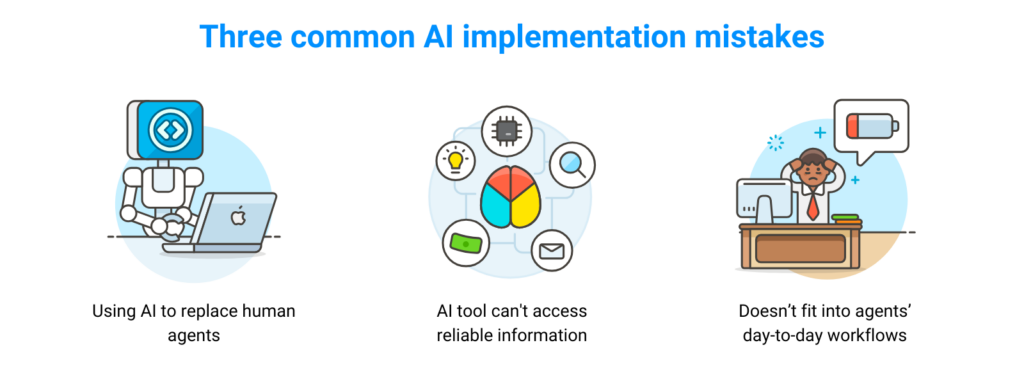
Mistake one: You’re using AI to replace human agents instead of supporting them
While technology can do many things, AI can’t replace humans. Your contact center agents still have a vital role to play in the customer experience. Eight out of 10 customers say they prefer speaking to a person for complex service issues.
However the issue isn’t choosing between humans or AI. Companies truly looking to get ahead will use a hybrid strategy that includes both humans and AI.
Human agents are mission-critical to the success of your contact center. Instead of using AI to replace them, you’ll need to use AI to help agents do their jobs better. Use AI in your customer service strategy to augment your human agents’ performance.
For example, you could use AI to improve the agent onboarding process so new hires can hit the ground running quickly and with confidence. You could also use tools like agent assist AI to coach them through live interactions, helping them diagnose and troubleshoot tech issues faster without losing the human touch that customers crave.
Mistake two: Your AI tool can't access reliable information
AI call center software is only as effective as the knowledge base it relies on. If your underlying support content is outdated, inconsistent or spread across disconnected systems, AI can't deliver the streamlined tech support experience you intended.
Many contact centers store troubleshooting steps, device instructions and service policies across multiple tools and documents. As a result, AI delivers inaccurate or conflicting answers, which leads to a poor customer service experience. Customers and agents notice these inconsistencies across channels, and both can quickly lose trust in the AI tool's recommendations.
This fragmentation creates a ripple effect. Agents stop relying on AI and revert to searching manually or escalating issues. Customers receive inconsistent support depending on who they speak with or where they start their journey. Over time, the AI tool becomes underused, and your company never sees the promised gains in efficiency.
To fix this, businesses need to strengthen their self-service knowledge base so that the AI delivers accurate results. That means centralizing support content, validating the accuracy of the information and ensuring consistent answers across every channel. When AI tools have access to accurate, trusted knowledge, they can provide effective guidance to both agents and customers.
As a result, agents gain confidence knowing the information surfaced during live interactions is reliable. In turn, customers benefit from faster, more accurate resolutions, and AI becomes an integral part of creating a more streamlined customer service experience.
Mistake three: AI doesn’t fit into agents’ day-to-day workflows
Even with access to a strong knowledge base, AI can still fail if it doesn’t naturally integrate into how agents actually work. Contact center agents operate under constant time pressure. They’re juggling multiple live conversations, tools, and customer expectations at once. If AI adds more to their already full plates or forces agents to switch tools, it quickly becomes a hindrance instead of a support mechanism.
This can cause AI adoption to stall. When guidance appears in the wrong place, arrives too late or requires agents to leave the interaction to access it, agents stop using it. No one wants to use a tool that interrupts their day-to-day workflow.
In telecom and broadband environments, this problem is even more pronounced. Agents may need to troubleshoot a wide range of devices, services and configurations in a single shift. If AI doesn’t surface relevant guidance in real time or align with existing workflows, it slows agents down rather than helping them resolve issues faster.
To address this, AI must be embedded in a way that supports the agent experience. Guidance should appear at the right time within the tools agents already use, without forcing them to leave the live interaction or current platform. When AI integrates naturally into the established workflow, agents are more likely to use it during live interactions.
When done right, AI reduces cognitive load instead of adding to it. Agents can stay focused on the customer, resolve issues more confidently and handle complex scenarios without unnecessary friction or interruptions.
How to get the most out of AI tools in your contact center
Now that you know the common mistakes that hinder AI adoption, how can you ensure your team is getting the maximum benefit from your AI tools? Below are a few tips to keep in mind.
Leverage AI to amplify your human agents’ performance
As mentioned previously, AI isn’t meant to replace your human agents. Telecom and broadband companies looking to leverage AI strategically in their contact centers should use AI to augment agent performance.
Instead of looking at AI through the lens of replacing people, ask yourself how you can use it to enhance their performance. For example, use AI to improve contact center agent productivity. AI can handle customers’ frequently asked questions or repetitive tasks, allowing agents to take on more complex tech support requests that require human expertise.
You can also use AI to create more personalized customer service experiences. AI can help agents tailor recommendations based on a customer’s previous service interactions or purchase history. When done right, using AI to enhance agent performance can improve your customer retention rate and net promoters score (NPS).
Use AI as part of an omnichannel customer service strategy
Customers rarely stick to a single support channel. For example, they might start troubleshooting an issue through self-service, switch to chat and then call your contact center. When these channels are siloed, customers have to repeat themselves, and agents lack the context they need to resolve their issues quickly.
AI can help bridge these gaps when used as part of an omnichannel customer service strategy. Instead of inconsistent experiences that vary by channel, AI can help maintain continuity across self-service, chat and agent-assisted support. That means preserving interaction history, serving up relevant knowledge and ensuring customers receive consistent answers no matter where they engage.
For telecom and broadband companies, this is especially important. Customers may troubleshoot on their own before escalating issues related to device setup, WiFi performance or service disruptions. When AI connects these touchpoints, agents can immediately see what steps the customer has already taken and avoid restarting the process from scratch. This reduces frustration and shortens resolution time.
Using AI across channels also improves customer self-service experiences. Customers who prefer to resolve issues on their own can access the same accurate guidance that agents rely on. When self-service and agent support are aligned, customers experience smoother handoffs.
Ultimately, AI works best when it supports the entire customer journey rather than isolated interactions. An omnichannel approach ensures AI enhances continuity, reduces friction and helps deliver a more cohesive support experience from start to finish.
There's a better way to use AI
AI can be a powerful differentiator for telecom and broadband companies, but only when used strategically. AI call center software often fails not because the technology is flawed, but because it's deployed for the wrong reasons, lacks access to accurate answers or decision-makers misunderstand how agents and customers actually interact.
The most effective AI strategies don't try to replace people. Instead, they focus on supporting agents with accurate knowledge, integrating naturally into daily workflows and delivering consistent experiences across channels. When AI is grounded in reliable information and aligned with current support operations, it helps agents resolve issues faster and with confidence.
For contact centers navigating rising expectations and increasing complexity, the path forward is to use AI to strengthen human support, reduce friction and streamline the customer experience.
Are you looking for more guidance on how to reap the benefits of AI customer service? Download our free e-book to learn more about how to use AI strategically to improve self-service and provide a better end-to-end customer experience. Grab your copy today.